

Root Canal Treatment in Turku
Juurihoidon tavoitteena on säilyttää oma hammas silloin, kun hampaan ydin on tulehtunut tai vaurioitunut. Moni hammas voidaan vielä pelastaa juurihoidolla, vaikka se aiheuttaisi voimakasta kipua tai röntgenkuvassa näkyisi juurenkärjen tulehdus. Dent Å:ssa juurihoito suunnitellaan huolellisesti, ja vaativissa tapauksissa voidaan hyödyntää erikoisosaamista, KKTT-kuvantamista ja operaatiomikroskooppia. Vastaanotollamme arvioimme, voidaanko hammas vielä hoitaa ja valitsemme yhdessä potilaan kanssa tilanteeseen parhaiten soveltuvan hoitovaihtoehdon hampaan ennuste huomioiden.
When is root canal treatment needed?
Root canal treatment may be needed when a tooth aches, hot or cold causes prolonged sensitivity, biting is tender or the pulp of the tooth has been damaged by deep decay or trauma. An inflamed tooth may also cause tenderness when biting, throbbing pain or sometimes no symptoms at all, appearing only as a finding on an X-ray. The earlier the situation is examined, the better the chances of saving the tooth usually are.
When should you seek root canal treatment?
- the toothache is severe or throbbing
- hot or cold causes prolonged pain even after the stimulus is removed
- biting on the tooth is painful
- there is swelling or pus in the gum
- the colour of the tooth has changed after an injury
- a previously root-treated tooth has started causing symptoms again
What is done during root canal treatment?
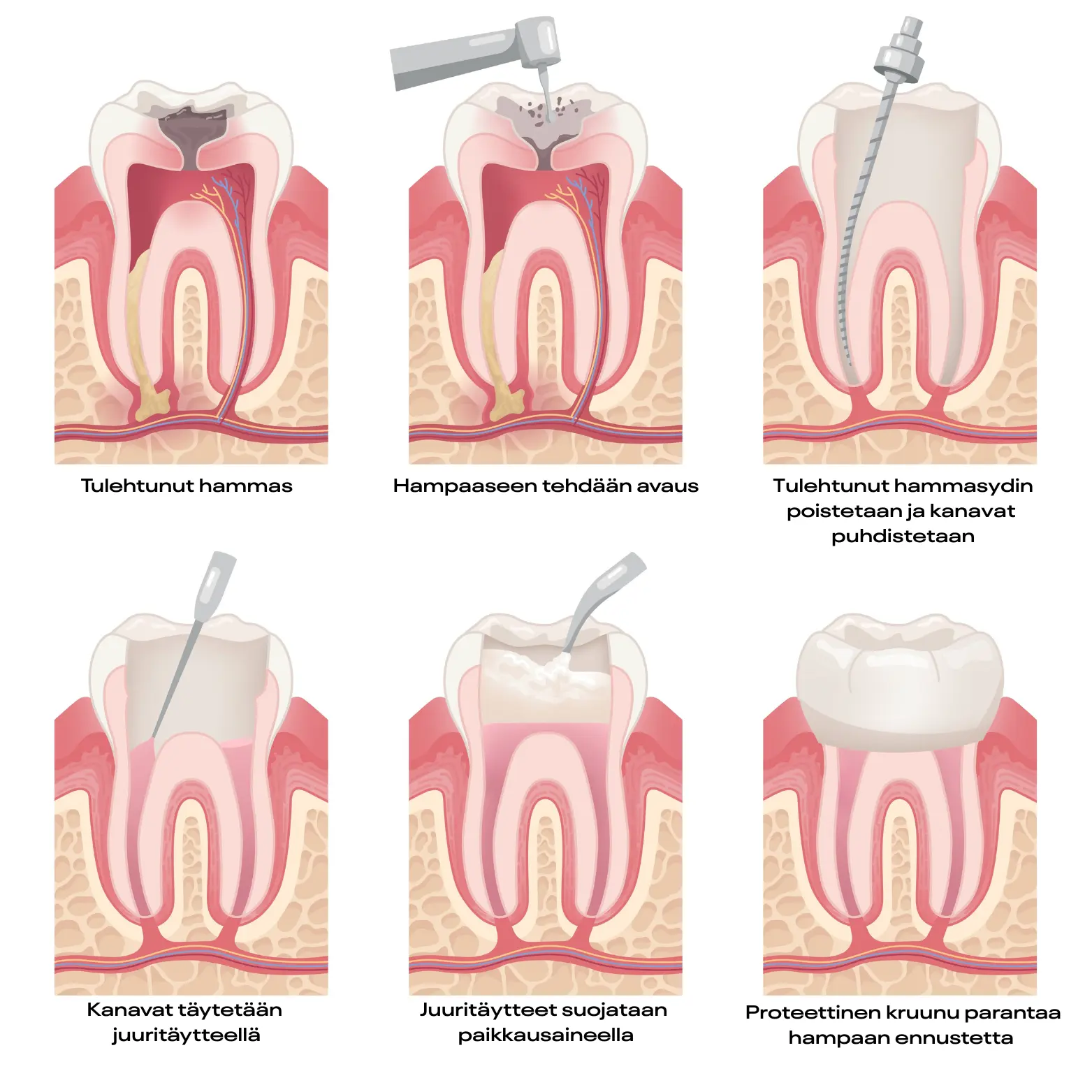
During root canal treatment, the inflamed or damaged tissue inside the tooth is removed, the root canals are cleaned and disinfected, and finally the canals are tightly filled. In more complex root canal treatments, an operating microscope can be used to work as precisely as possible. The aim is to eliminate the infection, prevent it from recurring and preserve your own tooth for as long as possible.
Why is root canal treatment worthwhile?
- your own tooth can often be saved
- the infection can be eliminated
- the pain is relieved
- tooth extraction is avoided
- the infection is prevented from spreading to the jawbone
Can a tooth always be root-treated?
Not always. If the structure of the tooth is too weak, it has an advanced crack or it cannot be reliably restored, extraction may be a better option than root canal treatment. The treatment decision is always based on the individual prognosis of the tooth.
When is complex root canal treatment needed?
Complex root canal treatment may be needed, for example, when the root canals are unusually narrow or curved, a previous root canal treatment has failed or the tooth has an extensive infection at the root tip. Treatment can also be complicated by a root canal instrument that has broken off in the canal, a post in the canal or another structure. In these situations, accurate diagnostics, good visibility and, where needed, CBCT imaging and an operating microscope help with planning and carrying out the treatment.
Customer reviews
Dent Å


a week ago

a month ago

a month ago

a month ago

2 kuukautta sitten
How root canal treatment works at Dentå
1. Examination and diagnosis
We assess the symptoms, examine the tooth and, if necessary, take X-rays or other images to clarify the situation.
2. Treatment plan
We go through whether the tooth can be saved with root canal treatment, how many appointments are likely to be needed and what the prognosis of the treatment is.
3. Cleaning the root canals
The inflamed tissue inside the tooth is removed. The canals are carefully cleaned and disinfected.
4. Filling the canals
When the canals are sufficiently clean and the situation allows, they are filled to seal them against bacteria.
5. Final restoration of the tooth
A root-treated tooth often needs a good permanent filling or crown so that it can withstand use and remain protected.
Does root canal treatment hurt?
Root canal treatment is often thought to be painful because it is frequently carried out only when the tooth is already causing severe pain. Numbing an inflamed tooth can then be more challenging than usual. With careful local anaesthesia, however, root canal treatment can be performed painlessly, and you will always receive instructions on recovery and any after-effects.
Root canal retreatment
If a previously root-treated tooth starts causing symptoms again, root canal retreatment is often a possible option. Treatment may also be considered when several years have passed since the previous root canal treatment. Before treatment, the cause of the symptoms is investigated and we assess whether saving the tooth is still a realistic and lasting option. Retreatment usually requires more planning and precision than usual and is often technically more demanding than the original root canal treatment.

Why choose Dentå for root canal treatment?
The aim of root canal treatment is to save your own tooth whenever it is possible in the long term. At Dentå, careful diagnostics, expertise in complex root canal treatment and modern examination and treatment methods come together. We offer root canal treatment in Turku flexibly, including in emergency situations, and our long opening hours make it easier to get treatment quickly, including in the evenings, at weekends and on public holidays.
Expertise in complex root canal treatments
We carry out both routine and complex root canal treatments, as well as retreatments. We always assess whether the tooth can be preserved predictably or whether another treatment option would be a better long-term solution.
Accurate diagnostics and modern technology
When needed, we use CBCT imaging and an operating microscope, which make it easier to examine and treat challenging root canals. Accurate diagnostics and careful planning help make treatment safer and more predictable.
Comprehensive treatment plan
Root canal treatment is often just one part of restoring a tooth. If needed, we plan further treatment in cooperation with experts in prosthodontics, periodontology or oral and maxillofacial surgery so that the function and long-term prognosis of the tooth are as good as possible.
A clear treatment path
Before treatment, we go through the examination findings, treatment options, prognosis, costs and any further treatment. This way, you can make your treatment decision based on sufficient information.
Frequently asked questions
Book a root canal assessment in Turku
Book a root canal assessment at Dentå and find out whether your tooth can still be saved.
Dentå, Kauppiaskatu 4, Turku. Tel. 020 112 3000.

